Warning: Undefined array key "uniqueId" in /home/gala/public_html/wp-content/plugins/generateblocks/includes/blocks/class-container.php on line 997
Journal of Queer Choral Studies
Volume 1, Issue 1 Now Available!
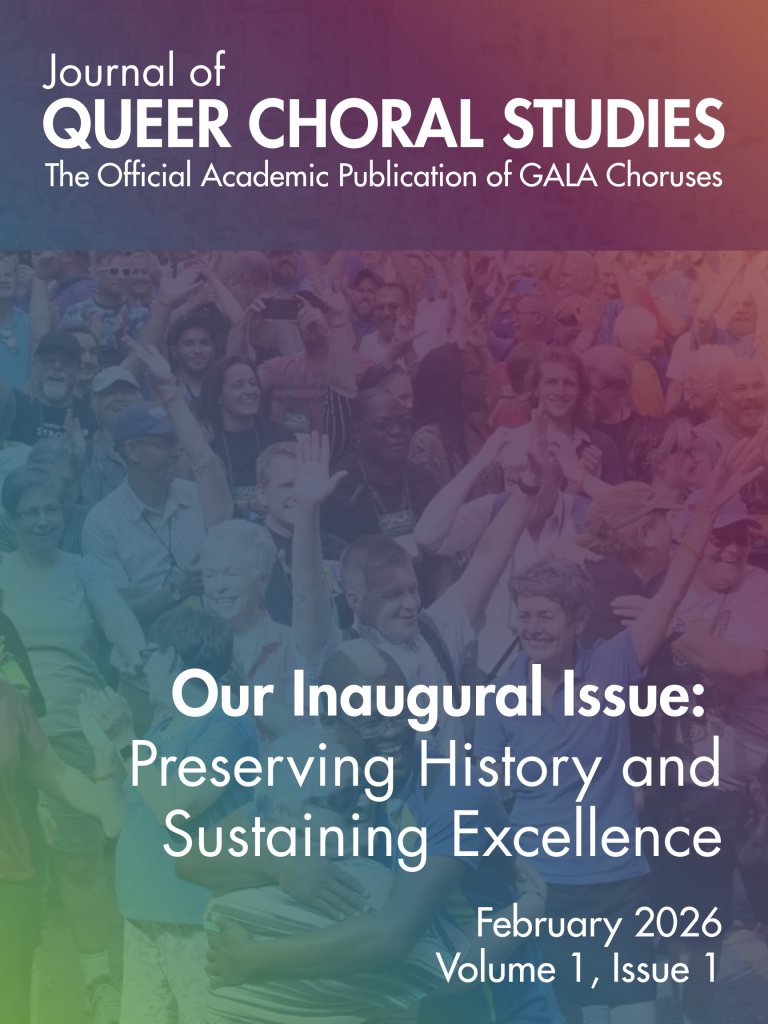
Journal of Queer Choral Studies: the Official Academic Publication of GALA Choruses
This online journal serves as a connection between GALA Choruses and choral music academics and practitioners. There is currently limited literature on the broad world of GALA Choruses and LGBTQIA+ choral issues. Journal of Queer Choral Studies gives researchers and music practitioners the ability to expand their knowledge about LGBTQIA+ community music-making, while offering GALA leadership easier access to important research in our field.
Why “Queer?”
The word “Queer” has a long and complicated history. Sadly, that history involves trauma and pain for many people. At that same time, many also find strength and comfort by reclaiming this word as their own. In many activist and academic spaces, “Queer” has become a word to describe LGBTQIA+ people and communities in an inclusive way, especially as a revolutionary concept for imagining a better world. We choose to call this publication a journal of “Queer Choral Studies,” in honor of that tradition, especially in academic spaces.
Download Individual Articles Below
Submissions for the Summer/Fall 2026 Issue Now Open!
The Journal of Queer Choral Studies (JOQCS), the official publication of GALA Choruses, is a peer-reviewed professional journal for articles by scholars, practitioners, and writers who have an important story to tell about their choral experiences.
JOQCS…
-disseminates information about new and unseen developments in the field of queer choral studies
-strengthens mutual understanding among academics and practitioners
-establishes a forum through which authors may help to improve and increase the theory and practice of choral studies
Three types of submissions are described below. All types of submissions are valued by the JOQCS:
1. ORIGINAL RESEARCH ARTICLE
Scholarly articles maintain full academic standards. Original research articles should document new findings, data, insights, and conclusions. Purpose, problem, and research questions should be included.
Definition and Characteristics:
- Original research articles using APA format with proper citations and methodology
- Quantitative, qualitative, mixed-methods, historical, and narrative inquiry are welcome
- Require academic rigor with title, byline, abstract, bio, and keywords
- Should include intro (with purpose/problems/research questions), review of literature, methodology, results, and discussion sections
- Literature reviews are also welcome under this category
- Approx. 3000-6000 words
Article Example: Taylor and Calaham (2024)
2. PRACTITIONER ARTICLE
A practitioner article is defined as academic work that combines scholarly research with practical application in choral settings. These articles will use APA format and include proper citations, methodology sections, and theoretical foundations while connecting research to real-world practice.
Definition and Characteristics:
- Academic rigor with proper citations and methodology
- Research that points to or informs practical applications
- Required to have title, byline, abstract, bio, and keywords
- Must demonstrate connection between scholarly work and choral practice
- Approx. 1000-3000 words
Article Example: Southerland (2018)
3. SPOTLIGHT ARTICLE
“Spotlights” from the field which are written in a more journalistic way. For this, reviewers will check that manuscripts are formatted according to the journal guidelines. A Spotlight is a more narrative-focused article with these distinctions:
- Definition and Characteristics:
- No academic style requirements
- More storytelling-oriented, like choir experience vignettes
- Don’t require extensive citations or theoretical foundations
- Could be simple narratives about choir experiences (like effects of a spiritual-themed concert)
- Designated as “choir experience spotlights” rather than traditional research
- Limited to two per journal issue
- Approx. 1000-3000 words
Article Example: Vanderburgh (2015)
******
Before submitting their articles for consideration, authors will complete the JOQCS Submission Form to indicate which style of submission describes their article of the Reviewer Process they prefer to participate in. They will submit the article title, all authors’ names, a short abstract (250–500 pp.) with keywords, and any acknowledgements.
Authors may choose which type of reviewer process they prefer to participate in.
Descriptions of the three reviewer processes follow:
Process 1 (double-anonymous peer review): This option is offered to meet the standards of many academic institutions. Submit articles with a separate cover page with the article’s title, all authors’ identifying and contact information, and brief biographies (100–250 words) for each of the authors with emails; also include any acknowledgements. On a new page, provide an abbreviated title running head for the article. Do not include any author identifying information in the body of the article, other than on the separate title page. Two peer reviewers will independently receive the article without the author’s information and without knowing the identity of the other reviewer. Each reviewer will recommend accepting the article for publication, accepting with revisions, or rejecting the article. Once the author(s) has made any changes to the satisfaction of the two peer reviewers, the manuscript will be sent to the Founding Editor-in-Chief for final determination.
Process 2 (open peer review): Usually, two members of the JOQCS Editorial Board will review the article. They will recommend accepting the article for publication, pursuing publication after suggested changes, or rejecting the article. If they decide the article is publishable with changes, the peer reviewers will email or call the primary author to discuss the suggested changes and serve as coaches in helping the author(s) prepare it for publication. Once the author(s) has made the changes to the satisfaction of the two peer reviewers, the manuscript will be sent to the Founding Editor-in-Chief for final determination.
Process 3 (mentorship/development): This option is offered to unpublished authors. It provides more time with a mentor-reviewer to refine the author’s thoughts and collaboratively prepare their manuscript for publication. Mentor/reviewers are generally from the JOQCS Editorial Board, and are seasoned, published authors. For this, reviewers will check that manuscripts are formatted according to the journal guidelines, and edit for clarity, accuracy, and adherence to the journal’s style and formatting guidelines. This can include copyediting for grammar and punctuation, fact-checking, and ensuring data is presented correctly. Reviewers will also offer author guidance, providing constructive feedback and guiding them through the revision process to help lead to a publishable article. When the article is publishable with changes, the mentor reviewer will send the semi-final article to the Editor-in-Chief for final determination.
Submit your manuscript for publication in the Summer/Fall 2026 Issue of JOQCS HERE
Deadline: June 1, 2026
Questions? Email Dr. Jessica L. Gallagher-Steuver (she/her), founding editor-in-chief, at joqcs@galachoruses.org.
Editorial Board
- Jessica Gallagher-Steuver, she/her – Founding Editor-in-Chief of JOQCS, AD of Windsong Cleveland, Lecturer of Music Education at Case Western Reserve University, Cleveland State University, and Baldwin Wallace Conservatory
- John Carrion, he/him – Executive Director of GALA Choruses, head of Big Apple Performing Arts (BAPA) and New York City Gay Men’s Chorus
- Jules Balén, ze/zym/zyr – Retired Faculty Development Director & Professor at California State University Channel Islands, author of A Queerly Joyful Noise
- Reese Schmid, she/her – GALA Membership and Communications Manager
- André de Quadros, he/him – Professor of Music at Boston University, human rights activist, author of multiple works including Empowering Song: Music Education from the Margins andMy Body Was Left On the Street – Music Education and Displacement
- Reina Dickey, she/her – Assistant Professor of Music at Miami University (Ohio), AD of MUSE, Cincinnati’s Women’s Choir
- Donald Callen Freed, he/him – Retired Professor and DCA at Sul Ross State University, part-time at Iowa Western Community College, composer, GALA Chorus member
- Kathleen Hansen, she/they – AD of San Diego Women’s Chorus, DMA Candidate at Boston University, GALA Festival Committee Co-Chair, GALA 411 Artistic Advisor
- Joshua Palkki, he/him – Associate Professor of Music at the Georgia Institute of Technology, co-author ofHonoring Trans and Gender-Expansive Students in Music Education
- Austin Norrid, he/him – Assistant Professor of Instruction for Choral Music Education at Ohio University
- Argerie Vasilakes, she/her – Editorial Board Member and Guest Editor of Organization Development Review, developer of award-winning writing/publication process for new authors, GALA Chorus member